Annemari Hongell
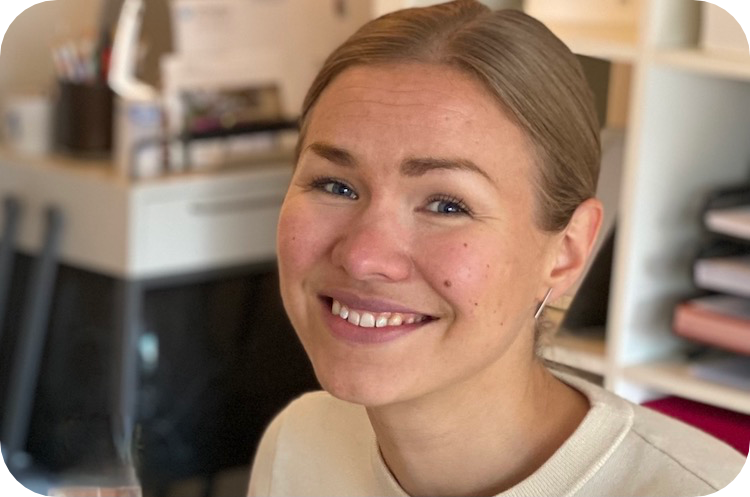
Speech Therapist (Turku)
Cognitive brief therapist
040 779 6733
annemari.hongell@puheklinikka.net
Annemari works with adult clients with neurological conditions, providing both individual and group speech therapy. She also offers guidance, therapy and training for voice disorders, and helps with difficulties in swallowing and eating. Annemari graduated as a speech and language therapist from Åbo Akademi University in 2015. In her Master’s Thesis, she collected Swedish-language normative data for the assessment tool Rapid Serial Naming Test.
Alongside her work as a speech and language therapist, Annemari offers support services for the family members of rehabilitation clients in the form of cognitive brief therapy.
Further training:
Adult neurological speech therapy: language-cognitive communication difficulties, cerebrovascular disorders, brain injuries, progressive neurological diseases, swallowing difficulties, neurogenic voice and fluency difficulties, functional voice therapy.
Selected training and qualifications:
The McNeill Dysphagia Therapy Program Certification, SPEAK OUT!®: A Practical Approach to Treating Parkinson’s, Supported Conversation for Adults with Aphasia (SCA™), LSVT LOUD Training and Certification, Better Conversations with Aphasia (BCA): Conversation Therapy for People with Aphasia and their Families, A Three-Part Treatment Plan for Oral Placement Therapy (OPT™ I), Deep Pharyngeal Neuromuscular Stimulation (DPNS & E-Stim Certification), Goal Attainment Scale (GAS), International Classification of Functioning, Disability and Health (ICF). Annemari is also trained as a cognitive brief therapist and uses this expertise with both rehabilitation clients and their family members.
Client groups:
- Young people, working-age adults and older adults
- Individual and group rehabilitation
- Subacute and maintenance rehabilitation
- Speech therapy assessment periods
- Guidance-focused speech therapy periods
- Cerebrovascular disorders: aphasia, dysarthria, dysphagia (swallowing difficulty), language-cognitive communication difficulties
- Progressive neurological diseases: Parkinson’s disease, ALS, MS, memory disorders
- Traumatic brain injuries and their after-effects
- Neurogenic voice and fluency difficulties
- Functional voice disorders, voice care, vocal ergonomics
- Assessment and rehabilitation of reading and writing difficulties (dyslexia)
Working languages: Finnish, Swedish, English.